
ACC Frequently Asked Questions

What is AAC?
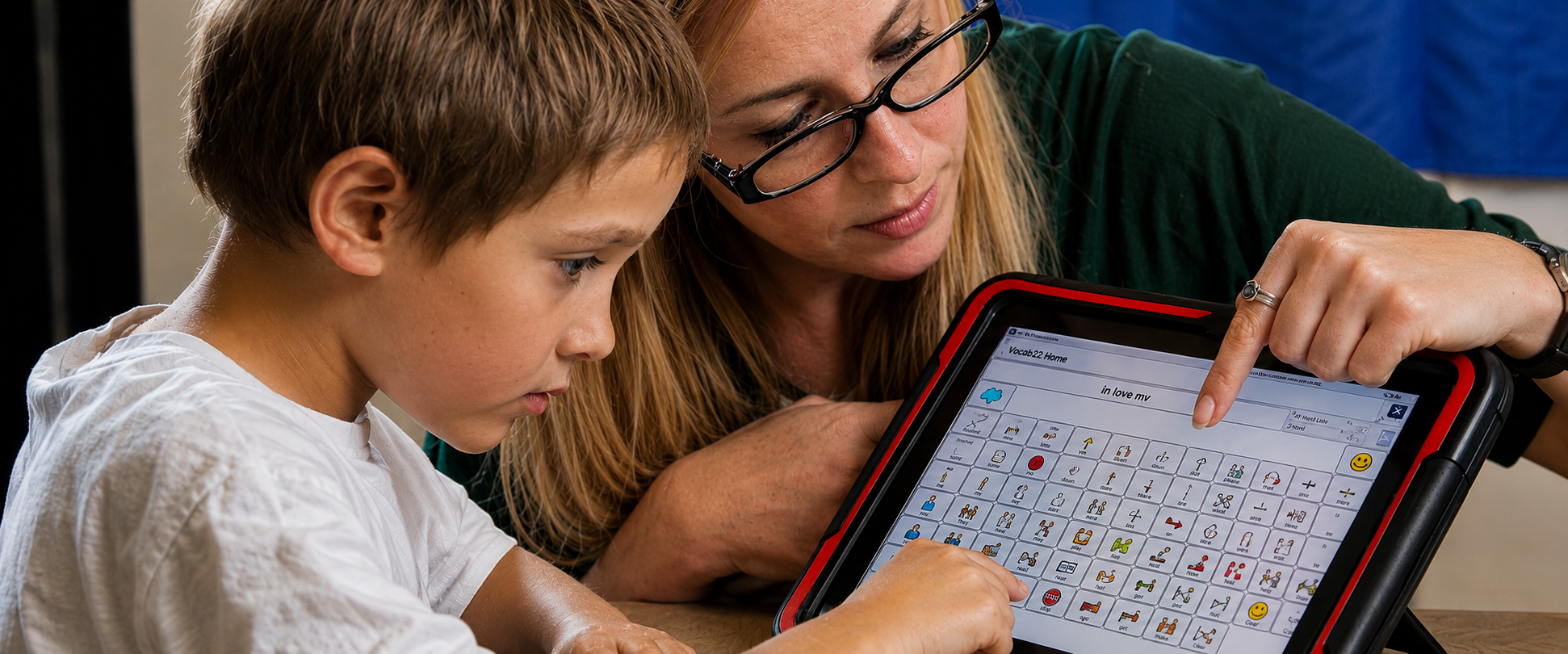
AAC stands for Augmentative and Alternative Communication. It includes any tool or strategy that helps a person communicate when speech is limited, unclear, or not yet reliable.
AAC can be low-tech, like gestures, pictures, or communication boards, or high-tech, like speech-generating devices that speak out loud when a child selects words or symbols.
AAC is simply another way to communicate.
Does AAC mean my child will never talk?
No. AAC does not stop speech development.
Research consistently shows that AAC often supports and encourages speech, especially when it is introduced early and used correctly. When children have a reliable way to communicate, they feel less pressure and frustration, which often makes vocal attempts more likely.
AAC and speech can grow together.
Is AAC only for children who will never speak?
No. AAC is helpful for many different communication profiles.
AAC supports:
- Children who are non-speaking
- Children with emerging or inconsistent speech
- Children who speak but are very difficult to understand
- Children who need visual or technological support to communicate clearly
Some children use AAC long-term. Others use it temporarily while speech develops. Both paths are valid.
What if my child is too young for AAC?
AAC can be introduced as early as age three, and sometimes earlier, when speech is very limited.
AAC does not require a child to understand language first. It actually helps children learn language. Waiting for speech to develop before offering AAC can delay communication and increase frustration.
Children deserve a way to communicate as soon as they need one.
Will using AAC make my child dependent on a device?
No. AAC does not create dependence.
AAC gives children access to communication. As speech becomes easier and more efficient, many children naturally use it more. AAC remains available as support, not as a barrier.
The goal is communication, not taking tools away.
What is a speech-generating device (SGD)?
A speech-generating device is a type of AAC system that speaks out loud when a child selects words or symbols on a screen.
Some SGDs are dedicated devices. Others are apps used on an iPad. Examples include TouchChat, Proloquo2Go, and LAMP Words for Life.
Each system is customized to match a child’s motor abilities, language level, and communication goals.
How does AAC help reduce frustration or behavior?
Many challenging behaviors happen when a child cannot express what they want, need, or feel.
AAC gives children a functional way to say things like:
- “I need help”
- “I want a break”
- “All done”
- “I don’t like that”
When children can communicate successfully, frustration often decreases and behavior improves naturally.
How does AAC help with learning and language?
AAC supports language development by:
- Pairing visual symbols with spoken words
- Supporting vocabulary growth and sentence building
- Helping children understand cause and effect in communication
- Supporting literacy through visual and spoken language connections
AAC helps children learn what language is for, even if speech is not yet reliable.
Will AAC work at home and school too?
Yes. AAC works best when it is used across environments.
At Integrated Speech & Behavior, we work closely with families, schools, and other therapy teams to help everyone support communication in consistent ways. AAC should not live only in therapy sessions. It should be part of daily routines, play, learning, and relationships.
Do parents need special training to use AAC?
Parents do not need to be experts, but support and guidance matter.
We help families learn how to:
- Model AAC naturally
- Encourage communication without pressure
- Respond to AAC use in everyday moments
- Build communication into routines at home
AAC works best when families feel confident and supported.
How do I know if AAC is right for my child?
If your child struggles to communicate effectively with speech alone, AAC may be helpful.
AAC is not a decision you have to make alone. A speech-language pathologist can assess your child’s communication, motor skills, and learning style and help determine what tools and strategies may be appropriate.
Exploring AAC does not lock you into anything.
What is IS&B’s approach to AAC?
At Integrated Speech & Behavior, AAC is a core part of how we teach communication.
We use AAC alongside vocal speech and articulation support, and we collaborate closely with families, schools, and ABA teams. Our goal is always the same: to give children a reliable way to be heard, understood, and connected.
Communication should never be something a child has to wait for.
Ready to Talk?

If you’re wondering whether this approach is right for your child, we’re happy to help you think it through.